2D vs 3D Game Development: Which Approach Is Right for Your Game Idea?
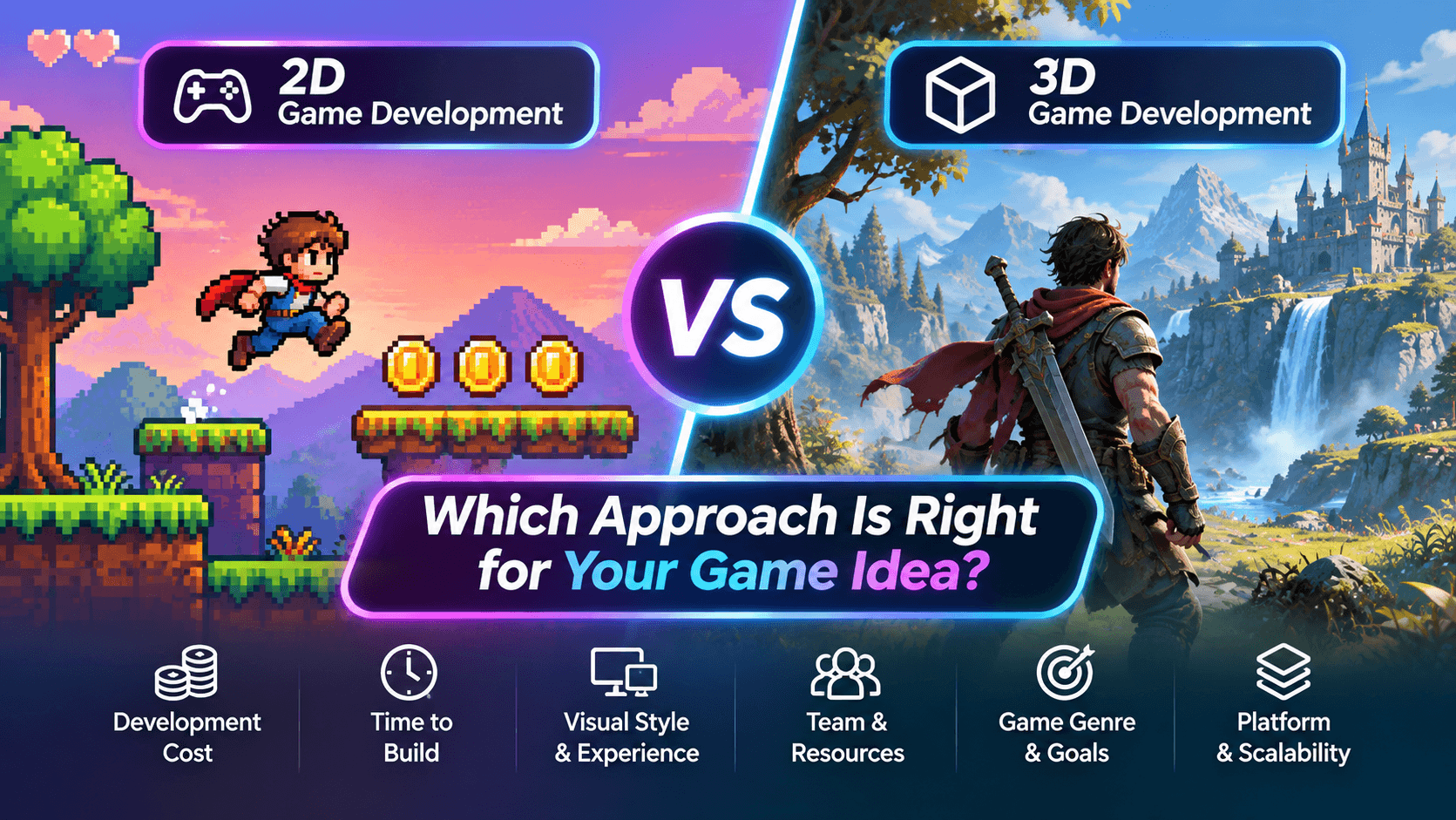
Every successful game starts with an idea. But before development begins, one important decision can shape the entire project: should you build your game in 2D or 3D?
Both approaches offer different creative and technical possibilities. A 2D platformer can deliver engaging gameplay through simple visuals and carefully designed mechanics, while a 3D adventure game can create immersive environments with depth, realistic movement, and interactive worlds.
However, choosing between 2D and 3D is not just about visual appearance. It affects development cost, production time, art requirements, gameplay mechanics, performance, team size, and the platforms you want to target.
A more detailed game does not automatically mean a better game. The right approach is the one that supports your gameplay concept and gives players the experience you want to deliver.
In this guide, we compare 2D vs 3D game development, explain their differences, explore their advantages and limitations, and help you decide which approach is right for your game idea.
What Is 2D Game Development?
2D game development involves creating games that primarily use two-dimensional graphics and gameplay. Characters, environments, objects, and animations are generally represented through sprites or flat visual assets.
Players usually interact with the game along two main axes: horizontal and vertical movement.
Popular examples include platformers, puzzle games, side-scrollers, card games, and many casual mobile games.
Some common characteristics of 2D games include:
- Sprite-based characters and environments.
- Side-scrolling or top-down gameplay.
- Two-dimensional physics and collision systems.
- Tile-based level design.
- Sprite animations and visual effects.
- Relatively straightforward camera systems.
2D does not mean visually simple or technically effortless. A polished 2D game can require detailed artwork, animation, complex gameplay systems, multiplayer functionality, and extensive testing.
How 2D Games Are Developed
A typical 2D development workflow begins with game concept planning and visual direction.
The team defines the gameplay mechanics, character movement, level structure, and overall art style. Artists then create sprites, backgrounds, character animations, and interface elements.
Developers implement the gameplay logic, collision detection, physics, audio, and progression systems. Afterward, the game is tested and optimized for its intended platforms.
Unity provides dedicated 2D tools such as sprites, Tilemaps, and 2D physics to support this workflow. Its official 2D game development documentation explains the available features and development resources.
What Is 3D Game Development?
3D game development involves creating interactive environments and objects with three-dimensional geometry.
Unlike traditional 2D games, 3D games can represent depth, perspective, and spatial movement. Players may move forward, backward, sideways, and vertically depending on the gameplay design.
Characters, environments, vehicles, weapons, and other objects are created using 3D models and brought to life through materials, textures, lighting, animation, and physics.
Common characteristics of 3D games include:
- Three-dimensional characters and environments.
- Perspective-based camera systems.
- 3D models, textures, and materials.
- Advanced lighting and shadows.
- Three-dimensional physics and collision detection.
- Character rigging and skeletal animation.
- More complex environment and camera management.
3D development offers greater flexibility for spatial gameplay, but it also introduces additional production and technical requirements.
How 3D Games Are Developed
A typical 3D game development process starts with concept design, gameplay planning, and environment visualization.
Artists create 3D models for characters, objects, and environments. These assets may require UV mapping, texturing, rigging, and animation before they can be integrated into the game.
Developers then implement character controllers, camera systems, physics, gameplay mechanics, artificial intelligence, and other features.
The game also needs lighting, rendering, optimization, and extensive testing to ensure that it performs reliably on target devices.
Unity supports 3D geometry, materials, textures, cameras, and interactive environments. Its official guide to 2D and 3D projects explains how these development modes differ.
2D vs 3D Game Development: 7 Major Differences
Although both approaches can produce engaging games, their development workflows and technical requirements are different.
Understanding these differences will help you select an approach that matches your project's goals.
1. Graphics and Visual Design
Visual design is usually the most noticeable difference between 2D and 3D games.
In 2D games, the visual experience is created using sprites, illustrations, backgrounds, animation, and visual effects.
Developers can choose from several styles, including:
- Pixel art.
- Hand-drawn illustrations.
- Cartoon graphics.
- Minimalist visuals.
- Vector-based artwork.
These styles can create distinctive gaming experiences without requiring three-dimensional environments.
3D games use models, textures, materials, lighting, and camera perspective to create a sense of depth.
Common 3D visual styles include:
- Realistic graphics.
- Stylized 3D environments.
- Low-poly art.
- Cartoon-style 3D characters.
- Cinematic environments.
Which approach should you choose?
Choose 2D if your game depends on illustration, pixel art, simple visual compositions, or a side-scrolling perspective.
Choose 3D if the experience depends on exploring environments, interacting with objects in space, or viewing characters and worlds from different angles.
Remember that visual quality depends on art direction and execution, not simply the number of dimensions.
2. Gameplay Mechanics and Player Interaction
Gameplay mechanics should have a major influence on your decision.
A 2D game can provide engaging gameplay through straightforward movement, timing, puzzles, combat, and carefully designed levels.
For example, a platformer may require precise jumping, obstacle avoidance, and character movement. These mechanics can work perfectly well without a three-dimensional environment.
A 3D game may require additional systems for spatial interaction, camera movement, navigation, and environmental physics.
For example, a third-person adventure game may need:
- Character movement in multiple directions.
- Camera tracking and rotation.
- Terrain navigation.
- Object interaction.
- Three-dimensional collision detection.
- Advanced character animation.
Which approach should you choose?
If your core gameplay works on a flat plane, 2D may be the more practical choice.
If your mechanics depend on spatial movement, environmental exploration, or interaction from multiple angles, 3D may be more suitable.
Do not add 3D simply because it looks more advanced. Choose it when depth actually improves the gameplay.
3. Development Cost and Budget
Development cost is another important consideration.
In many projects, 2D games are less expensive to produce because their asset pipelines can be simpler. Developers may need sprites, backgrounds, and animations instead of complete three-dimensional characters and environments.
However, the final cost depends on the game's scope and features.
A complex 2D multiplayer game with hundreds of levels, online systems, and advanced animations can still require a substantial budget.
3D projects often involve additional production tasks, including:
- Character modeling.
- Environment modeling.
- Texturing and materials.
- Rigging and animation.
- Lighting and rendering.
- Camera and physics systems.
- More extensive visual testing.
These requirements can increase the time and resources needed to complete the project.
Which approach should you choose?
If you have a limited budget and your gameplay does not require depth, a well-planned 2D project may be a sensible starting point.
If your game depends on immersive environments or three-dimensional interaction, the additional 3D production effort may be justified.
For a more detailed look at project budgeting, read our guide on Unity Game Development Cost in 2026.
4. Development Time and Production Workflow
A 2D project can often move through production faster because its visual asset pipeline may involve fewer technical steps.
Creating a sprite and integrating it into a game can be simpler than modeling, rigging, texturing, and animating a comparable 3D character.
However, this does not mean every 2D game is quick to develop. Complex gameplay, large numbers of levels, custom animations, and backend features can still extend the schedule.
3D development generally involves additional asset preparation and technical work.
The production process may require:
- Modeling and sculpting.
- UV mapping and texturing.
- Character rigging.
- Skeletal animation.
- Lighting and material setup.
- Environment optimization.
- Camera and physics testing.
Large 3D environments may also require additional optimization to maintain performance.
Which approach should you choose?
Choose 2D when your project needs a relatively focused visual pipeline and you want to validate the core gameplay efficiently.
Choose 3D when the intended experience requires detailed environments, spatial interaction, and more advanced visual presentation.
The best way to estimate development time is to define your features and create a prototype before committing to a production schedule.
5. Performance and Device Requirements
Performance is an important consideration, particularly for games targeting smartphones and lower-powered hardware.
2D games often have relatively straightforward rendering requirements. However, large textures, particle effects, complex shaders, and excessive visual elements can still affect performance.
3D games may require more processing resources because of:
- Complex geometry.
- High-resolution textures.
- Dynamic lighting.
- Real-time shadows.
- Advanced materials.
- Physics calculations.
- Complex animation systems.
These requirements can make optimization more demanding.
However, a carefully optimized 3D game can perform well on mobile devices, while a poorly optimized 2D game can still suffer from lag and stuttering.
Which approach should you choose?
For a broad mobile audience, 2D may offer a practical way to manage visual complexity.
If you choose 3D, define your minimum device requirements early and optimize assets, rendering, and memory usage accordingly.
Testing on real devices is essential regardless of the approach.
6. Animation and Character Movement
Animation brings characters, objects, and environments to life.
In 2D games, animation may use sprite sheets, frame-by-frame artwork, or skeletal 2D animation.
Common examples include:
- Walking and running cycles.
- Jumping and landing.
- Attack animations.
- Character expressions.
- Environmental effects.
In 3D games, characters usually require models, skeletons, rigging, and animation systems.
Developers may need to create different animations for movement, combat, interactions, and other gameplay situations.
3D character animation can also involve blending between movements and ensuring that animations work correctly from different camera angles.
Which approach should you choose?
Choose 2D if your visual direction depends on illustrated or sprite-based characters.
Choose 3D if characters need to move naturally through a three-dimensional environment or interact with objects from different directions.
The animation requirements should follow the gameplay design rather than dictate it.
7. Team Skills and Development Resources
The type of game you build also influences the specialists you need.
A 2D project may require:
- Game developers.
- 2D artists.
- Animators.
- Game designers.
- UI/UX designers.
- QA testers.
A 3D project may require additional specialists, such as:
- 3D modelers.
- Texture artists.
- Character riggers.
- 3D animators.
- Technical artists.
- Lighting artists.
- Environment designers.
Not every project needs a large team. Smaller games can be developed by compact teams or experienced independent developers.
The important thing is to match the team's capabilities with the production requirements.
2D vs 3D Game Development: Which Genres Work Best?
Your game's genre can help narrow down the decision.
Some genres naturally fit a two-dimensional perspective, while others benefit from three-dimensional environments.
Game Genres That Work Well With 2D Development
Platformer Games
Platformers often focus on jumping, running, obstacles, and level progression. A 2D perspective can make movement and level design easier to communicate.
Puzzle Games
Puzzle games usually rely on logic, patterns, object placement, and problem-solving. Many can deliver a complete experience without three-dimensional environments.
Card and Board Games
Card games, chess, checkers, and other board games often work well with 2D interfaces because the gameplay revolves around clear visual layouts and player decisions.
Casual Mobile Games
Simple arcade games, matching games, and tap-based experiences can benefit from lightweight visual designs and straightforward controls.
Side-Scrolling Adventure Games
Side-scrolling games can use 2D artwork to create memorable characters, environments, and gameplay experiences.
Game Genres That Work Well With 3D Development
First-Person Shooters
First-person shooters often depend on three-dimensional environments, camera control, weapon handling, and spatial navigation.
Racing Games
3D environments can provide realistic tracks, vehicle movement, camera perspectives, and environmental interaction.
Open-World Games
Open-world experiences often require large environments, navigation systems, interactive objects, and spatial exploration.
Simulation Games
Vehicle, construction, flight, and other simulation games may benefit from three-dimensional models and physics systems.
Third-Person Adventure Games
These games often depend on character movement, camera control, combat, exploration, and interaction with detailed environments.
These are common use cases, not strict rules. A game can combine different visual styles and gameplay perspectives if that better supports the concept.
What Is a 2.5D Game? A Middle Ground Between 2D and 3D
You do not always have to choose between traditional 2D and full 3D development.
A 2.5D game combines elements of both approaches.
For example, a game may use three-dimensional characters and environments while restricting player movement to a two-dimensional plane.
Other games use 2D artwork arranged in a three-dimensional scene to create depth and parallax effects.
Common 2.5D approaches include:
- 3D characters in side-scrolling gameplay.
- Isometric environments with restricted movement.
- 2D sprites arranged at different depths.
- Three-dimensional backgrounds with a fixed camera.
- 3D environments with two-dimensional gameplay mechanics.
A 2.5D approach can provide a distinctive visual style without requiring the full spatial complexity of traditional 3D gameplay.
Unity's official 2D and 3D project guide explains how 2D gameplay can use 3D graphics and how different camera configurations affect project setup.
Can You Convert a 2D Game Into 3D Later?
Technically, it is possible to expand a 2D game into a 3D experience. However, it is not always a simple upgrade.
A project built around two-dimensional movement and sprite-based assets may need significant changes to support three-dimensional environments.
The development team may need to rebuild:
- Character models and animations.
- Environment assets.
- Camera systems.
- Physics and collision detection.
- Player movement.
- Lighting and materials.
- Level design.
- Performance optimization.
The reverse is also true. Converting a 3D game into a 2D experience may require redesigning its camera, gameplay mechanics, assets, and interaction systems.
This is why it is important to consider the intended experience before full production begins.
You do not need to finalize every technical detail immediately, but your initial architecture should account for the direction in which the game may grow.
How to Choose the Right Approach for Your Game Idea
If you are still unsure whether to build your game in 2D or 3D, consider the following questions.
1. What Is the Core Gameplay Experience?
Start by identifying what players will actually do in your game.
If the experience revolves around solving puzzles, jumping between platforms, or interacting with a flat interface, 2D may be enough.
If players need to explore environments, navigate in three dimensions, or interact with objects from different angles, 3D may be more appropriate.
2. What Visual Style Fits Your Concept?
Think about how you want players to experience your game world.
Does your idea depend on pixel art, hand-drawn environments, or stylized illustrations?
Or does it require detailed environments, realistic characters, and dynamic camera movement?
Your art direction should support the concept rather than add unnecessary production requirements.
3. What Is Your Development Budget?
Estimate the cost of programming, art production, animation, testing, and post-launch support.
Do not choose 2D simply because you assume it will always be cheaper. A content-heavy 2D game can still require significant resources.
Similarly, do not assume that every 3D project needs a massive budget. A small, stylized 3D game can be developed with a controlled scope.
4. Which Platforms Will You Target?
Consider whether your game will launch on Android, iOS, PC, consoles, or multiple platforms.
Think about controls, display sizes, device performance, and platform-specific requirements.
A mobile game may need touch-friendly controls and careful memory optimization, while a PC game may need keyboard, mouse, and controller support.
5. What Can Your Development Team Build?
Evaluate your team's experience with game programming, 2D artwork, 3D modeling, animation, and technical optimization.
The best approach is often the one your team can implement efficiently without introducing unnecessary technical challenges.
6. What Is Your Long-Term Plan?
Think beyond the first release.
Will the game receive new levels, characters, environments, multiplayer features, or seasonal content?
A development approach should support the game's future roadmap, not just its initial launch.
Common Mistakes to Avoid When Choosing Between 2D and 3D
Making the wrong decision early can increase development time and create unnecessary expenses.
Avoid these common mistakes:
Choosing 3D Only Because It Looks More Advanced
A 3D environment does not automatically create better gameplay. If your concept works perfectly in 2D, additional dimensions may introduce unnecessary complexity.
Underestimating 2D Production Work
2D games still need strong artwork, animation, level design, gameplay programming, and testing. A simpler visual pipeline does not mean a project requires no planning.
Ignoring Target Device Performance
A visually impressive game may struggle on devices that cannot handle its rendering requirements. Define your target hardware early and test regularly.
Adding Too Many Features Before Validating Gameplay
Developers sometimes spend months building additional systems before confirming that the core gameplay is enjoyable.
Start with a playable prototype and validate the central experience first.
Selecting an Engine Before Defining Requirements
The engine should support your game concept. First define the mechanics, visual style, platforms, and technical requirements. Then evaluate the available tools.
How WebBuggs Can Help You Build Your Game
Choosing between 2D and 3D is only the beginning of a successful game development project.
You also need the right development strategy, technical architecture, production workflow, and testing process.
WebBuggs provides game development services for projects that require gameplay programming, Unity development, multiplayer functionality, cross-platform support, and performance optimization.
Whether you are planning a 2D mobile game, a 3D adventure, or a more complex gaming experience, the development approach should be based on your requirements and long-term goals.
Explore our game development services to learn more about how we can support your project.
You can also explore our Unity game developers if you need experienced developers for your next game.
For a real example of a complete game development journey, take a look at our Logistics Battalion Steam Game case study.
Frequently Asked Questions About 2D vs 3D Game Development
Is 2D or 3D game development better?
Neither is universally better. 2D is often suitable for platformers, puzzle games, and casual experiences. 3D is more appropriate when gameplay depends on spatial movement, exploration, and three-dimensional environments. The best choice depends on your game concept and requirements.
Is 2D game development cheaper than 3D?
In many cases, yes. 2D games can have simpler asset-production requirements and a more straightforward workflow. However, development cost depends on gameplay complexity, content volume, team size, platforms, and other features.
Is 3D game development harder than 2D?
3D development often involves additional work in modeling, rigging, texturing, lighting, animation, and optimization. However, the difficulty depends on the project. A complex 2D multiplayer game can be more technically demanding than a small 3D prototype.
Can Unity be used for both 2D and 3D games?
Yes. Unity supports both 2D and 3D development. It provides dedicated tools for sprites, Tilemaps, 2D physics, 3D models, materials, cameras, and interactive environments.
What is the difference between 2D and 2.5D games?
Traditional 2D games primarily use flat graphics and two-dimensional gameplay. A 2.5D game combines elements of 2D and 3D, such as three-dimensional characters with side-scrolling movement or 2D artwork arranged in a scene with depth.
Which is better for mobile game development: 2D or 3D?
Both approaches can work for mobile games. 2D may be suitable for casual, puzzle, and platformer games, while 3D can support racing, action, and simulation experiences. Device performance, visual requirements, and gameplay mechanics should guide the decision.
Can a small indie team develop a 3D game?
Yes. Small teams can develop 3D games by keeping the project scope realistic, using suitable assets, prioritizing essential features, and building a manageable production pipeline.
Which approach is better for a first-time game developer?
A small 2D project can be a practical starting point because it allows beginners to learn core gameplay programming, animation, physics, and level design without managing a complex 3D asset pipeline. However, beginners can also start with 3D if that is what their game idea requires.
Final Thoughts
Choosing between 2D and 3D game development is not about deciding which technology is more advanced. It is about selecting the approach that best supports your game's mechanics, visual identity, budget, and target audience.
2D development can be an excellent choice for platformers, puzzle games, casual experiences, and projects built around illustrated visuals.
3D development is often more suitable for games that require spatial exploration, detailed environments, realistic interactions, and advanced camera systems.
You can also explore a 2.5D approach when your idea benefits from combining two-dimensional gameplay with three-dimensional visuals.
Before investing in full production, define your core gameplay, create a prototype, test the experience, and evaluate the technical requirements.
The right game development approach is not the one with the most impressive graphics. It is the one that brings your game idea to life in the most effective way.
2D vs 3D Game Development: Which Approach Is Right for Your Game Idea?
Unity Game Development Cost in 2026: What Does It Really Take to Build a Game?