.svg)


Migrating from No-Code to Real Code: When Bubble/Webflow Stops Scaling With You
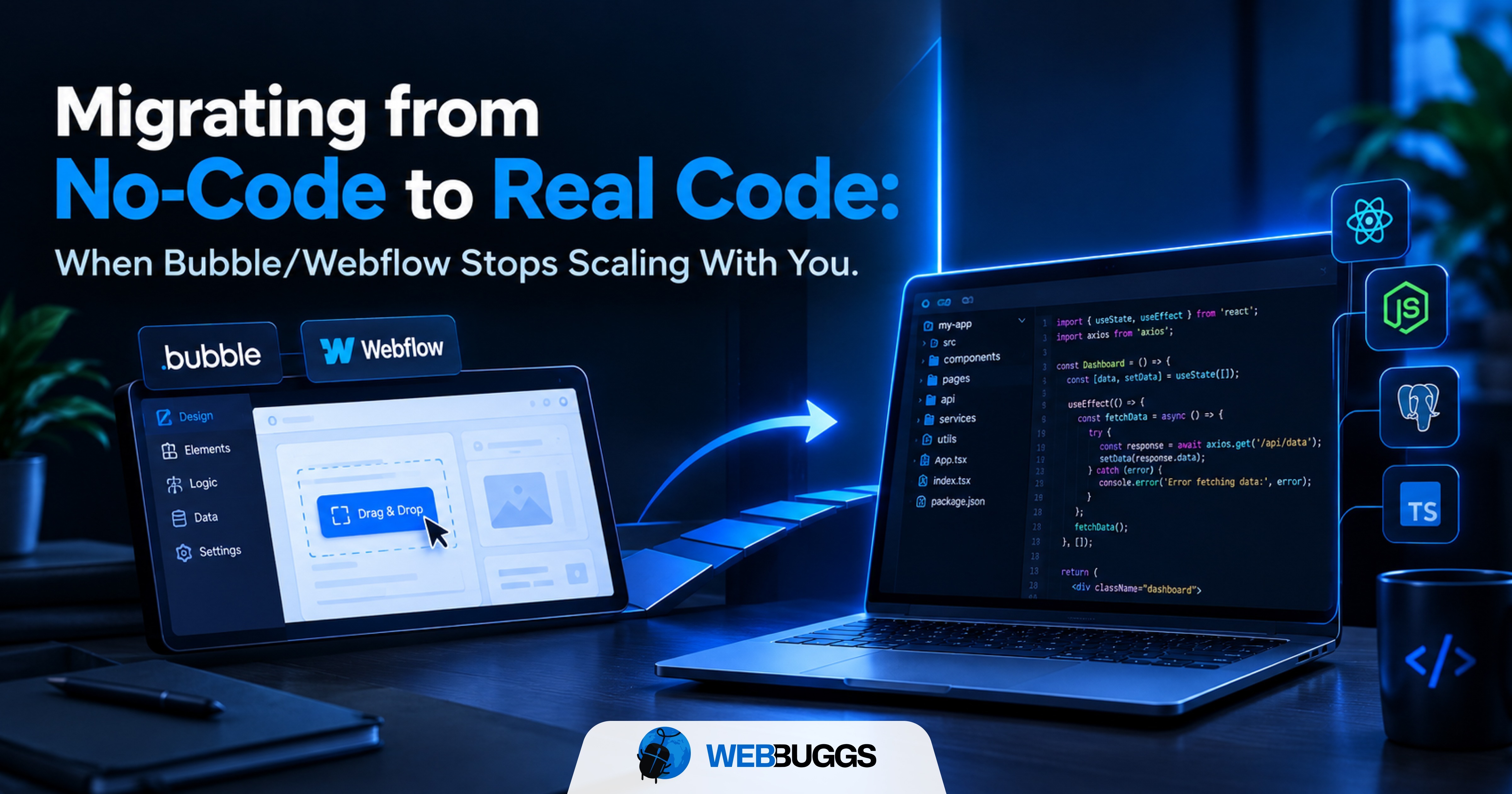
No-code platforms are excellent at getting an idea into users' hands quickly. You can build an MVP, validate demand, automate workflows, launch landing pages, create customer portals, and even run a growing SaaS product without assembling a traditional engineering team.
Then something changes.
Your Bubble app becomes slower as workflows and records multiply. A feature that sounds simple requires increasingly complicated workarounds. Your Webflow site needs application logic that the CMS was never designed to handle. Integrations become fragile. Platform costs rise. Your developers spend more time working around platform constraints than building the product.
That is usually when the conversation shifts from “How do we scale our no-code app?” to “Should we rebuild this in code?”
A no-code to code migration is the process of moving a product from a visual development platform such as Bubble or Webflow to a software architecture where your team controls the application code, backend logic, database, infrastructure, integrations, and deployment process.
It does not mean no-code failed.
Often, no-code did exactly what it was supposed to do: it helped you reach the point where your product requirements became more sophisticated than the original platform.
At WebBuggs, we approach these migrations as product and architecture projects, not simple platform conversions. Our Web Application Development work focuses on preserving what already works while rebuilding the parts that are limiting performance, maintainability, integration, or future growth.
The question is not whether custom code is theoretically more powerful.
The question is whether your current product has reached the point where owning more of the technology becomes worth the additional engineering responsibility.
What Is No-Code to Code Migration?
No-code to code migration is the process of rebuilding or replacing a no-code application's functionality with a custom-coded software stack while preserving the product's important data, workflows, user experience, integrations, and business rules.
It is usually not a matter of pressing “Export” and continuing development in React.
A production application is more than its interface.
It may contain:
- User accounts and authentication
- Database records and relationships
- Business rules
- Automated workflows
- Permissions and roles
- API integrations
- Payment logic
- Notifications
- File storage
- Search
- Analytics
- Scheduled jobs
- Admin functionality
- SEO-sensitive pages
- Third-party services
A successful migration has to identify which of those capabilities exist today, decide which ones should survive, and recreate them deliberately in the new architecture.
That is why no-code to custom code migration should be treated as a software migration, not a design conversion.
Does Migrating From No-Code Mean Rebuilding Everything From Scratch?
Usually, you should expect significant rebuilding, but “from scratch” can be misleading.
You are not starting with nothing.
Your existing product has already given you something extremely valuable: evidence.
You know which screens users visit.
You know which workflows matter.
You know which features nobody uses.
You know your data model.
You know which integrations are critical.
You have customer feedback.
You may already know where the current architecture breaks.
The new application code may need to be written separately because no-code platforms generally do not translate an entire production application directly into a clean, maintainable custom codebase.
But the product itself should not be rediscovered from zero.
The existing application becomes the specification.
No-Code Is Not the Problem
No-code often gets criticized once a company outgrows it.
That misses the point.
If Bubble helped you validate a SaaS idea in three months instead of spending a year building infrastructure before finding product-market fit, it created enormous value.
If Webflow allowed your marketing team to launch and iterate independently, it solved a real organizational problem.
No-code platforms can be excellent for:
- MVPs
- Prototypes
- Marketing websites
- Internal tools
- Simple marketplaces
- Customer portals
- Workflow automation
- Early-stage SaaS products
- Content-heavy websites
- Business process applications
Problems begin when the product's requirements move beyond the assumptions of the platform.
You should migrate because the economics or technical requirements have changed, not because “real developers use code.”
When Should You Move From No-Code to Code?
You should consider moving from no-code to custom code when platform constraints repeatedly affect performance, product development, integrations, data architecture, operating costs, or your ability to implement important business requirements.
One workaround is not a reason to rewrite a product.
A repeating pattern of workarounds is.
Here are the signals that deserve attention.
Sign 1: Performance Gets Worse as Your Application Grows
A Bubble application with a small dataset and a few workflows may perform very differently after it accumulates large datasets, complex searches, privacy rules, plugins, integrations, and interconnected workflows.
The same principle applies to any application platform.
Growth increases the amount of work the system has to perform.
Watch for Performance Symptoms
Your users may report:
- Slow initial page loads
- Delayed searches
- Filters taking several seconds
- Slow dashboards
- Lag after clicking actions
- Long-running workflows
- Timeouts
- Delayed background processing
- Poor performance during traffic spikes
Before blaming the no-code platform, measure the problem.
Bad application design can make custom code slow too.
A migration only makes sense if platform constraints prevent you from solving the underlying bottleneck effectively.
If dashboards are one of your major performance problems, our guide on why dashboards load slowly and how to optimize dashboard load time explains how database queries, request waterfalls, oversized payloads, frontend processing, caching, and rendering combine to create delays.
No-Code Scalability Is More Than User Count
People often ask:
“How many users can Bubble handle?”
That is usually the wrong question.
Two applications with 10,000 users can have completely different workloads.
One might have users opening a profile twice a week.
Another may process live events, large searches, complex permissions, notifications, file uploads, and hundreds of data operations per session.
Scalability depends on workload, not just account count.
Measure:
Concurrent activity.
Database volume.
Query complexity.
Workflow frequency.
API calls.
Payload sizes.
Background jobs.
Real-time connections.
That gives you a much better picture of whether you are approaching a no-code scalability problem.
Sign 2: Simple Features Require Complicated Workarounds
A healthy platform lets your team express the product reasonably clearly.
A platform mismatch forces increasingly creative hacks.
You may find yourself saying:
“We can build it, but…”
Then comes:
We need three plugins.
We need another automation.
We need to duplicate this workflow.
We need an external database.
We need custom JavaScript.
We need a serverless function.
We need to sync data into another service.
We need a workaround because the platform does not support this permission model.
Each workaround can be reasonable individually.
The architecture becomes fragile when workarounds become the normal way of developing the product.
Track Workaround Density
A useful migration signal is not the number of features your no-code platform cannot support.
It is the percentage of important new features that require you to work outside the platform's intended architecture.
If most roadmap items require exceptions, custom scripts, external services, and duplicated logic, you may already be maintaining a distributed custom application without receiving the benefits of owning the core codebase.
Sign 3: Your Database Model Is Fighting the Product
Early-stage data models are rarely perfect.
That is fine.
But as the application grows, you may need:
- More complex relationships
- Advanced querying
- Full-text search
- Large analytical workloads
- Better indexing
- Data warehousing
- Event history
- Complex reporting
- Strict transactional behavior
- Specialized storage
- Data partitioning
At some point, the database capabilities available through your current platform may become a constraint.
Data Architecture Matters More as the Product Matures
An MVP asks:
Can we store the data?
A mature product asks:
Can we query millions of records efficiently?
Can we guarantee data consistency?
Can we audit changes?
Can we isolate tenants?
Can we build analytics without affecting transactional workloads?
Can we move data into a warehouse?
Can we implement backup and recovery requirements?
Those are different questions.
No-code platform limitations become more visible as the questions become more technical.
Sign 4: Integrations Are Becoming Your Architecture
Early products may need Stripe, email, analytics, and one or two external APIs.
Growing products often need much more.
You may eventually integrate:
CRM systems.
ERP software.
Accounting platforms.
AI services.
Search infrastructure.
Data warehouses.
Customer identity systems.
Communication tools.
Partner APIs.
Internal enterprise systems.
The problem is not having many integrations.
The problem is when the no-code application becomes a fragile chain connecting services through plugins, webhooks, and automations that nobody can confidently trace.
You Need Better Control Over Failure
What happens when an API fails?
Do you retry?
How many times?
Can the same webhook be processed twice?
What happens if the service is unavailable for 30 minutes?
Can you replay failed events?
Can you see which integration caused an order to fail?
Custom development gives you more control over those decisions.
It also makes you responsible for implementing them correctly.
Sign 5: Real-Time Features Are Getting Complicated
Chat, live dashboards, collaborative editing, presence indicators, live tracking, and notifications introduce a different class of architecture.
You may need:
- WebSockets
- Server-Sent Events
- Pub/sub systems
- Message queues
- Event streams
- Background workers
- Connection state
- Replay mechanisms
- Distributed messaging
A prototype can sometimes hide that complexity behind plugins.
A production system cannot ignore it.
If real-time functionality has become central to your product, read our guide to WebSocket mistakes that kill application performance.
The important lesson applies to migration too.
Do not rebuild a fragile no-code real-time system as a fragile custom-coded real-time system.
Use the migration to fix the architecture.
Sign 6: Platform Costs No Longer Match the Value You Receive
No-code can be financially attractive early.
You avoid much of the cost of building infrastructure and internal tooling.
As usage increases, the economics can change.
Costs may be influenced by factors such as:
- Application workload
- User or editor seats
- Storage
- Traffic
- Workflow execution
- API usage
- CMS limits
- Add-ons
- Plugins
- External automation tools
- Higher platform tiers
Do not compare platform subscription cost against a server bill and conclude that custom code is cheaper.
That comparison is incomplete.
Custom software also requires:
Developers.
Infrastructure.
Monitoring.
Security maintenance.
Backups.
Testing.
Deployment.
Incident response.
Dependency updates.
Performance optimization.
The correct comparison is total cost of ownership.
Sign 7: Platform Lock-In Is Blocking Important Decisions
Platform lock-in becomes a problem when your roadmap depends on capabilities you cannot reasonably control.
For example:
You need a specific database architecture.
You need infrastructure in a particular region.
You need custom authentication behavior.
You need specialized security controls.
You need a proprietary integration.
You need advanced background processing.
You need deeper observability.
You need functionality that depends on platform roadmap decisions.
Lock-in itself is not automatically bad.
Every technology choice creates dependencies.
AWS creates dependencies.
React creates dependencies.
PostgreSQL creates technical assumptions.
The important question is whether the dependency still provides more value than constraint.
Sign 8: Your Team Is Afraid to Change the App
This is one of the strongest warning signs.
A product becomes dangerous to maintain when developers avoid touching certain workflows because nobody knows what else will break.
You may have:
- Duplicate logic
- Hidden dependencies
- Old experiments still running
- Plugins nobody understands
- Automations calling automations
- Inconsistent naming
- Conflicting workflows
- Unclear ownership
This is technical debt, regardless of whether the system was built with code or no-code.
Migration creates an opportunity to remove it.
Do not migrate every mistake.
That defeats the purpose.
We discuss the same pattern in AI Coding Tools Broke Your Codebase? Here's How to Rescue a v0/Bolt/Lovable Project Before It Collapses. Rapid development can produce working software while quietly accumulating structural problems underneath.
The lesson is the same.
Fast development and maintainable architecture are different goals.
You eventually need both.
Bubble to Custom Code: When Does Migration Make Sense?
Bubble to custom code migration makes sense when Bubble's current architecture consistently prevents you from meeting important performance, integration, data, security, maintainability, or product requirements.
Do not migrate simply because your application has become successful.
Success alone is not a technical problem.
Common Reasons for Migrating From Bubble
A growing Bubble application may reach a point where the team wants:
More direct control over backend architecture.
A conventional relational database.
Specialized query optimization.
Custom infrastructure.
More sophisticated background processing.
Advanced observability.
Complex third-party integrations.
Greater control over frontend performance.
A larger conventional engineering ecosystem.
Those requirements can make custom development increasingly attractive.
Do Not Rebuild Bubble Screen by Screen
This is one of the easiest migration mistakes to make.
Old Bubble application:
Page A → rebuild Page A.
Page B → rebuild Page B.
Workflow X → recreate Workflow X.
Workflow Y → recreate Workflow Y.
That sounds safe.
It can also reproduce years of technical debt in a new programming language.
Instead, ask:
Why does this workflow exist?
Is it still used?
Can two workflows become one service?
Should this calculation happen in the frontend or backend?
Should this data structure exist at all?
Migration should preserve business behavior, not necessarily implementation.
Webflow to Custom Code: When Does Migration Make Sense?
Webflow migration to custom development is a different problem because Webflow is commonly used for content and marketing experiences rather than the same application workloads as Bubble.
A growing Webflow site may need custom development when the website starts becoming an application.
Examples include:
Complex authenticated experiences.
Advanced customer dashboards.
Highly dynamic account-specific data.
Sophisticated backend workflows.
Complex permissions.
Deep product integrations.
Large-scale application state.
Specialized search.
Custom commerce logic.
Do Not Migrate a Great CMS Experience Without a Reason
If your marketing team loves Webflow and it performs its job well, you may not need to replace it.
A hybrid architecture may be better.
For example:
Webflow for marketing pages.
Custom application for authenticated product functionality.
That separation can preserve marketing velocity while giving the product engineering team the control it needs.
No-code vs custom development does not have to be an all-or-nothing decision.
No-Code vs Custom Code for Scalability
The better option depends on what you are scaling.
AreaNo-CodeCustom CodeInitial developmentUsually fasterUsually requires more engineeringPrototype iterationExcellentMore setup requiredInfrastructure controlPlatform-dependentHighDatabase controlPlatform-dependentHighCustom integrationsMay require plugins/workaroundsHighly flexiblePerformance tuningLimited to available controlsFine-grainedMaintenance burdenMore handled by platformMore owned by your teamDeploymentSimplifiedTeam-controlledTechnical flexibilityConstrained by platformHighEngineering responsibilityLowerHigher
Custom code gives you control.
Control creates flexibility.
It also creates responsibility.
Your team now owns the architecture decisions the no-code platform previously handled.
That tradeoff should be intentional.
How to Migrate From No-Code to Custom Code
A safe no-code to code migration starts with understanding the existing product before writing its replacement.
The migration can be divided into six stages.
Step 1: Audit the Existing Application
Create an inventory before writing code.
Document:
- Pages and screens
- User roles
- Workflows
- Database objects
- Data relationships
- Integrations
- Plugins
- API calls
- Scheduled jobs
- Emails
- Notifications
- Payment flows
- Permissions
- Authentication
- File storage
- Analytics
- SEO-sensitive URLs
Then classify each item.
Keep.
Change.
Remove.
Unknown.
That last category matters.
If nobody knows why a workflow exists, investigate it before rebuilding it.
Use Actual Product Behavior as Your Specification
Documentation is often outdated.
Observe the production product.
Review analytics.
Interview users.
Check support tickets.
Trace important workflows.
Screenshot key states.
Record edge cases.
You are not simply migrating software.
You are migrating business behavior.
Step 2: Remove Features You Should Not Migrate
Migration is one of the best opportunities you will get to reduce product complexity.
Use it.
A feature used by 0.2% of customers but responsible for 15% of architectural complexity deserves scrutiny.
Do not automatically migrate:
Abandoned experiments.
Old integrations.
Unused admin tools.
Duplicate workflows.
Deprecated product plans.
Temporary workarounds.
Dead database fields.
Unused plugins.
Every feature you remove is one less feature to rebuild, test, secure, and maintain.
Step 3: Design the New Architecture Around Current Requirements
Do not pick a technology stack because it is fashionable.
Start with requirements.
What traffic must the application handle?
What data does it store?
How complex are the relationships?
Does it need real-time communication?
What security model is required?
What background jobs exist?
How quickly must developers ship?
What skills does the team already have?
What does the product need to become in two years?
A possible web application stack might include:
Frontend: React or Next.js
Backend: Node.js, NestJS, Python, Go, or another suitable runtime
Database: PostgreSQL
Cache: Redis where justified
Storage: Object storage
Background processing: Queue and workers
Monitoring: Application and infrastructure observability
Deployment: Cloud infrastructure appropriate to the application
That is an example, not a universal migration stack.
Architecture should follow requirements.
Step 4: Migrate and Clean the Data
Data migration deserves its own plan.
Do not leave it until launch week.
Export the Existing Data
Identify everything that needs to move:
Users.
Organizations.
Transactions.
Content.
Files.
Relationships.
Settings.
Permissions.
Historical records.
Audit data where required.
Map the Old Schema to the New Schema
Your no-code database structure may not map directly to the new relational or document model.
Create explicit mappings.
For example:
Old User Company field → organization_id
Old list of permissions → role and permission tables
Old text status → validated enum
Old nested records → normalized relationships
Clean Before Importing
Migrations reveal years of data quality problems.
Look for:
Duplicates.
Null values.
Orphaned records.
Invalid emails.
Broken references.
Old test accounts.
Inconsistent dates.
Deprecated statuses.
Do not blindly transfer bad data into a cleaner architecture.
Validate Data Integrity
After migration, verify:
Record counts.
Relationships.
Financial totals.
User ownership.
Permissions.
Files.
Historical records.
Critical business metrics.
“Import completed successfully” does not mean the data is correct.
Step 5: Plan Authentication Carefully
Authentication migration is often underestimated.
Your existing platform may manage password storage and user sessions internally.
Your new application may use:
A managed identity provider.
Custom authentication.
OAuth.
Enterprise SSO.
Passkeys.
Another authentication architecture.
You need to determine whether credentials can be migrated safely or whether users need a password reset or another reauthentication flow.
Plan communication before cutover.
A technically successful migration that locks customers out is not successful.
Step 6: Migrate in Phases Instead of Betting Everything on Launch Night
Avoid a giant switch where possible.
A safer migration looks like:
Old application remains operational.
New application reaches feature parity for critical workflows.
Data synchronization is tested.
Internal users move first.
A small customer cohort follows.
Monitoring confirms stability.
More users move.
Old application becomes read-only where appropriate.
Final data reconciliation happens.
Old platform is decommissioned after verification.
The exact cutover strategy depends on your application.
The principle is simple.
Reduce the amount of irreversible change happening at once.
Do Not Migrate Technical Debt Into a New Codebase
A rewrite can feel clean for approximately five minutes.
Then teams start recreating the old shortcuts.
“We need this feature before launch.”
“Just copy the old logic.”
“We'll refactor it later.”
“We only need this temporary workaround.”
Six months later, the new application has inherited the same structural problems.
Preserve Behavior, Not Bad Architecture
If the old system performs five sequential workflows because the no-code platform required it, your custom application does not necessarily need five services doing the same thing.
Redesign around the business requirement.
This is also why migration estimates can be misunderstood.
Stakeholders see 40 screens.
Engineers see:
40 screens.
17 integrations.
8 user roles.
A legacy database.
Authentication migration.
Payment webhooks.
File migration.
Background jobs.
Data validation.
Monitoring.
Deployment.
Regression testing.
Rollback.
Our article Your Developer Said It'll Take 2 Weeks explores why apparently simple development work often expands once hidden dependencies and testing requirements become visible.
Migration projects expose those dependencies very quickly.
How Long Does No-Code to Custom Code Migration Take?
There is no reliable universal timeline.
A five-screen internal tool and a mature SaaS application built over four years are both “no-code apps.”
They are not comparable migration projects.
Timeline depends on:
Number of screens.
Workflow complexity.
Data volume.
Data quality.
User roles.
Integrations.
Authentication.
Payment systems.
Real-time features.
Files.
SEO requirements.
Testing requirements.
Compliance.
Cutover strategy.
Feature changes included in the migration.
The fastest way to estimate migration is to inventory the existing product and estimate capabilities rather than screens alone.
Should You Migrate Everything at Once?
Usually, not if the architecture allows meaningful separation.
A strangler-style migration can replace parts of the old system gradually.
For example:
Phase 1: Move the public frontend.
Phase 2: Move authentication and accounts.
Phase 3: Move critical dashboard functionality.
Phase 4: Move background workflows.
Phase 5: Move remaining data and administration.
Phase 6: Decommission the no-code application.
Your product may require a different sequence.
The benefit is risk reduction.
Users do not need to experience your architecture migration as a single dramatic event.
When You Should Not Migrate From No-Code
Not every growing no-code application needs custom development.
Stay on the platform when:
Performance remains acceptable.
The platform supports your roadmap.
Your team can maintain the application confidently.
Costs remain reasonable.
Integrations work reliably.
Security and compliance requirements are met.
Users are satisfied.
Custom development would not create meaningful business value.
Migrating because custom code feels more “professional” is a poor reason to spend months rebuilding a working product.
Optimize Before You Rewrite
Sometimes the real problem is not the platform.
It is:
Poor database design.
Unnecessary workflows.
Bad queries.
Too many plugins.
Large media.
Unoptimized frontend behavior.
Duplicated automation.
Weak caching.
Fixing those issues may buy years of additional platform life.
Migration should solve a demonstrated constraint.
How to Decide: Optimize, Hybridize, or Migrate
You do not have only two options.
There are three.
Option 1: Optimize the Existing No-Code Application
Best when the platform still fits the product and the problems are implementation-specific.
Option 2: Use a Hybrid Architecture
Keep the platform where it provides value.
Move constrained functionality into custom services.
For example:
Webflow marketing site + custom SaaS application.
No-code admin interface + custom backend.
No-code workflows + specialized data processing service.
Option 3: Migrate the Core Product to Custom Code
Best when the platform repeatedly limits critical requirements and hybrid architecture would create more complexity than it removes.
Choose based on product constraints, not engineering identity.
Our guide Agile Isn't Broken. Your Agile Is. discusses what happens when development teams confuse constant activity with effective delivery.
A migration needs controlled progress, not an endless stream of changing requirements.
How WebBuggs Approaches No-Code to Custom Code Migration
A successful migration should leave you with a better product architecture, not merely the same product written in another language.
That is why our Web Application Development approach starts with understanding the existing system before choosing what replaces it.
We look at:
Current user journeys.
Business-critical workflows.
Data architecture.
Performance bottlenecks.
Integrations.
Authentication.
Permissions.
Background processing.
Real-time requirements.
Frontend architecture.
Infrastructure.
Observability.
Security requirements.
Migration risk.
Then we separate three categories.
What should remain exactly as users know it?
What should be redesigned because the existing platform forced a workaround?
What should disappear because nobody needs it anymore?
Only then does the target architecture become clear.
The objective is not to replace Bubble with React or Webflow with Next.js.
The objective is to remove the technical ceiling without losing the product value you already built.
Frequently Asked Questions
What is code migration in coding?
Code migration is the process of moving software from one technology, platform, architecture, runtime, or environment to another. It may involve rewriting application logic, transforming data, replacing integrations, changing infrastructure, and validating that the new system preserves required behavior.
Is no-code development the future?
No-code will likely remain an important part of software development because it makes many applications faster and less expensive to create. It does not eliminate the need for custom development. Complex products may combine no-code tools with custom code depending on performance, control, integration, security, and scalability requirements.
What are the top 10 no-code platforms?
Popular no-code and low-code platforms include Bubble, Webflow, Glide, Softr, FlutterFlow, Adalo, AppSheet, Airtable, Zapier, and Make. They serve different purposes, so the right platform depends on whether you are building a website, web application, mobile application, internal tool, database workflow, or automation.
What is migration code?
Migration code is code written to transform an existing system into a new structure or environment. Examples include database migration scripts that create new tables, transform fields, move records, update schemas, or convert legacy data into a format the new application can use.
How to build a no-code website?
Choose a no-code website platform based on your requirements, create the site structure, design reusable components, configure content and CMS collections, connect forms or integrations, optimize responsive layouts and SEO, test the site, and publish it. Webflow and similar platforms can handle much of this visually without requiring traditional frontend development.
Will coding exist in 5 years?
Coding is likely to remain important even as AI and no-code tools automate more software creation. The work may shift toward architecture, system design, validation, integration, security, debugging, and directing automated development tools, but complex software will still require technical reasoning and control over how systems behave.
The Goal Is Not to Escape No-Code. It Is to Remove the Ceiling.
Bubble or Webflow helping you build the first version of your product is not technical debt by definition.
It may have been one of your best early technical decisions.
It allowed you to test the market before investing heavily in custom infrastructure.
But the architecture that gets a product from zero to its first customers is not always the architecture that gets it to the next 100,000.
Watch the signals.
Performance keeps declining.
Critical features require workarounds.
Data architecture is becoming restrictive.
Integrations are fragile.
Real-time functionality is getting complicated.
Platform economics have changed.
Your roadmap increasingly depends on capabilities you do not control.
When those constraints become recurring business problems, no-code to code migration becomes worth evaluating.
Do not start by choosing React.
Do not start by rebuilding screens.
Do not start by asking AI to rewrite your Bubble application.
Start by documenting what your product actually does.
Keep what creates value.
Delete what does not.
Redesign what was built around platform limitations.
Migrate the data carefully.
Move users gradually when possible.
Test the new system against real production behavior.
Then retire the old platform only when the replacement has proved it can carry the business.
The goal of migrating from no-code to custom code is not to turn a no-code application into a coded application.
It is to give a growing product an architecture that can keep growing with it.
.jpg)