.svg)


Real-Time Features Not Working? The WebSocket Mistakes Killing Your App's Performance
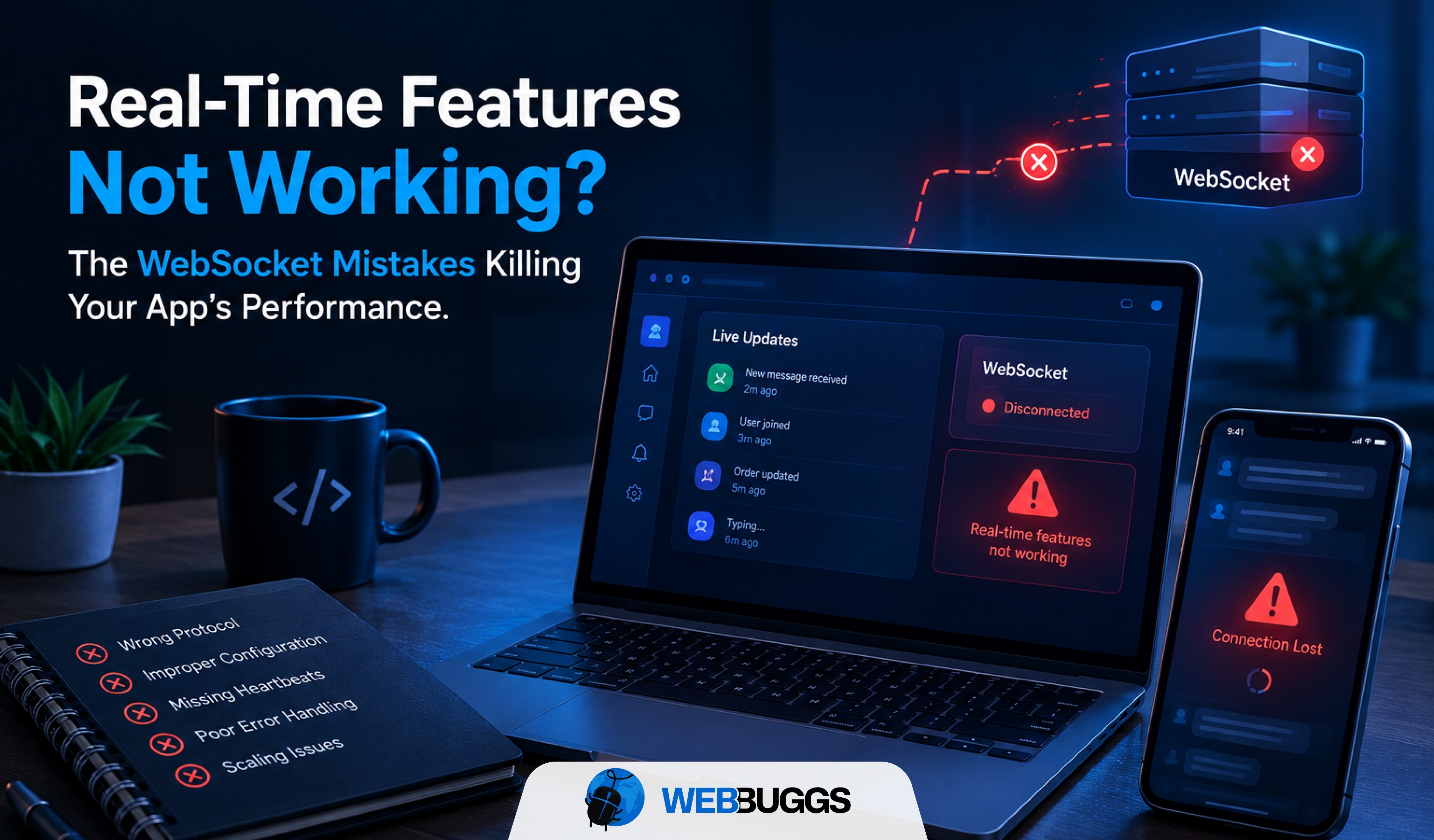
Your chat messages arrive five seconds late. Live notifications stop until the user refreshes the page. Presence indicators randomly show active users as offline. Everything works perfectly on localhost, but production connections keep dropping.
At first, WebSockets look like the obvious suspect.
The real problem is usually deeper.
Most WebSocket performance problems come from poor connection management, aggressive reconnect logic, oversized messages, unnecessary broadcasts, missing backpressure controls, slow application code, or infrastructure that was never configured for long-lived connections.
At WebBuggs, we see this pattern often in applications that add real-time functionality after the core product has already grown. The feature may begin as a simple notification system and later expand into chat, presence, dashboards, live tracking, collaborative updates, and synchronization across thousands of users.
At that point, a WebSocket is no longer a small feature. It becomes part of your application architecture.
If your real-time functionality keeps failing, start by identifying where the event flow actually breaks instead of increasing timeouts or adding another reconnect function.
Why Are WebSocket Problems So Hard to Diagnose?
WebSocket bugs are difficult to diagnose because WebSocket connections are persistent. A connection can succeed initially and fail several seconds or hours later because of application logic, network conditions, connection lifecycle problems, proxies, load balancers, or overloaded clients.
Traditional HTTP debugging often follows a simple pattern.
The browser sends a request.
The server processes it.
The server sends a response.
The request ends.
WebSockets behave differently.
After the initial handshake, the connection can remain open while the client and server continuously exchange messages.
That long-lived state creates more places where something can fail.
A typical real-time event may travel through:
User action → Application logic → Database → Event system → WebSocket server → Network → Browser → Client state → UI
If the user receives an update three seconds late, the WebSocket itself may have delivered the message almost instantly.
The delay could have happened before the message ever reached the socket.
An Open WebSocket Is Not Necessarily a Healthy WebSocket
One common mistake is assuming that because the application still reports an open connection, communication is healthy.
Networks change.
Mobile users switch between Wi-Fi and cellular connections.
Routers drop inactive connections.
Proxies terminate idle sessions.
Devices enter sleep states.
A connection can become unusable without your application immediately understanding what happened.
WebSocket implementations therefore need proper connection lifecycle management rather than a simple connect-once approach.
Why “It Works Locally” Tells You Very Little
Your local development environment is unusually friendly.
You probably have:
Few users.
Low latency.
No production load balancer.
No reverse proxy complications.
Stable connectivity.
Almost no concurrent connections.
Minimal message volume.
Production introduces all of those missing variables.
That is why a WebSocket implementation can run for hours during development and start disconnecting minutes after deployment.
Mistake 1: Using WebSockets When You Do Not Need WebSockets
A feature being “real time” does not automatically mean it needs WebSockets.
WebSockets provide persistent two-way communication between the client and server. They make sense when both sides frequently need to send information.
That added capability comes with additional operational complexity.
You now have to manage:
Connections.
Disconnections.
Heartbeats.
Authentication.
Reconnection.
State recovery.
Connection limits.
Infrastructure timeouts.
Horizontal scaling.
Message delivery.
For a simple update stream, that complexity may provide little benefit.
WebSockets vs Server-Sent Events
Server-Sent Events, usually called SSE, allow a server to continuously send updates to a browser over an HTTP connection.
The communication primarily moves in one direction.
Server → Client
That works well for features such as:
Live status updates.
News feeds.
Monitoring information.
Progress indicators.
Event streams.
Notifications.
If the browser rarely needs to send real-time messages back over the same persistent channel, SSE may be simpler.
WebSockets vs Polling
Polling periodically asks the server whether anything has changed.
For example:
Client requests updates every 30 seconds.
Server returns new information.
Client waits another 30 seconds.
That is inefficient for extremely frequent updates but perfectly acceptable for many products.
A dashboard that refreshes a metric every minute does not necessarily need a permanent WebSocket connection.
Mistake 2: Creating Too Many WebSocket Connections
Opening one WebSocket connection is cheap enough that developers often stop thinking about connection count.
Then a React application grows.
The notifications component opens one socket.
The chat component opens another.
The dashboard opens another.
A page rerenders.
A component remounts.
A route changes.
Cleanup fails.
Reconnect logic creates another socket before the previous connection closes.
One user may now hold several active connections.
Multiply that across thousands of users and you have a serious performance problem.
The One Socket Per Component Problem
Frontend components should not blindly own persistent connections when several parts of the application need the same real-time channel.
In many applications, a better structure is:
Application-level WebSocket manager → Single shared connection → Event distribution → Individual components
Components subscribe to the information they need rather than opening independent network connections.
This also makes reconnection, authentication, heartbeat handling, and cleanup easier to manage.
Clean Up Connections Properly
When the user leaves the relevant page or application, close connections that are no longer needed.
Also remove:
Event listeners.
Timers.
Retry callbacks.
Subscription handlers.
Heartbeat intervals.
MDN recommends closing WebSocket connections when the user is finished with a page, noting that an open WebSocket can also affect browser back/forward cache behavior.
A disconnected socket with active timers and listeners can continue creating problems long after the UI that created it disappears.
Mistake 3: Assuming a Connected Socket Will Stay Healthy
Long-lived connections need health checks.
WebSocket ping and pong frames exist partly for this reason. A server can send a ping and use the response to determine whether the client remains reachable.
Without a heartbeat strategy, dead connections can remain in your connection registry longer than they should.
Zombie Connections Waste Resources
Imagine a user closes their laptop without properly terminating the session.
The server still believes the connection exists.
Then another user disappears in similar circumstances.
Then another.
Eventually, thousands of stale connections may remain associated with resources, listeners, rooms, or application state.
Proper heartbeat handling helps the server identify connections that no longer respond.
Do Not Pick an Arbitrary Heartbeat Interval
There is no universal heartbeat interval that fits every application.
Your choice depends on factors such as:
Required failure detection speed.
Infrastructure timeout values.
Expected connection volume.
Bandwidth constraints.
Client behavior.
Mobile usage.
A trading system may need faster detection than a low-priority notification feed.
The goal is not to send heartbeats as often as possible. The goal is to detect broken connections reliably without creating unnecessary traffic.
Mistake 4: Reconnecting Every Client Immediately
Automatic reconnection sounds harmless until your application experiences a real outage.
Imagine 30,000 active clients.
Your WebSocket server restarts.
All 30,000 connections disappear.
Every browser immediately executes:
Reconnect.
Reconnect.
Reconnect.
Your server comes online and instantly receives thousands of connection attempts.
Authentication systems get hit.
Databases get hit.
Connection handlers get hit.
The recovery process overloads the service again.
You have created a reconnection storm.
Use Exponential Backoff
Instead of reconnecting at a fixed rapid interval, increase the delay between failed attempts.
The pattern might conceptually look like:
First retry: short delay.
Second retry: longer delay.
Third retry: longer again.
Continue until reaching a reasonable maximum.
Add Jitter
Backoff alone can still synchronize clients.
If thousands of browsers disconnect at exactly the same moment and use exactly the same backoff schedule, they may retry together again.
Jitter adds randomness to the delay.
Now clients return gradually rather than in one synchronized wave.
Reauthentication Matters Too
Long-lived connections create another problem.
The authentication token used during the initial connection may expire while the session remains active.
Your reconnect logic therefore needs to understand authentication state.
Do not endlessly reconnect with an expired token.
Refresh credentials when appropriate, validate the new session, and then restore the connection.
Mistake 5: Sending Too Much Data
A persistent connection reduces repeated connection setup. It does not create unlimited bandwidth.
If one field changes, sending the entire application state may be wasteful.
Imagine a collaborative document.
One user changes a single character.
Your server sends the entire document to every collaborator.
Another character changes.
The entire document goes out again.
That approach may work in a prototype.
It becomes expensive as document size, activity, and user count increase.
Send Changes Instead of Full State When Appropriate
For high-frequency systems, consider whether you can send smaller updates.
Instead of:
Entire object.
Consider:
Object identifier.
Changed property.
New value.
Version or sequence identifier.
Timestamp where needed.
The right model depends on your synchronization requirements, but the principle is simple.
Do not move data that the receiver does not need.
Watch Serialization Costs
Network transmission is only part of the cost.
Before sending a large JSON object, the server may need to:
Build it.
Serialize it.
Copy it.
Place it into buffers.
Send it.
The client then needs to:
Receive it.
Parse it.
Update state.
Rerender the affected interface.
That work can become significant at high message frequencies.
Mistake 6: Broadcasting Every Message to Every User
This is one of the easiest ways to destroy scalability.
Suppose your application has 10,000 connected users.
One event occurs.
You send it to all 10,000 connections.
Now imagine 100 events per second.
Even if individual messages are small, your server is doing enormous amounts of unnecessary work.
Most users probably do not need most events.
Use Rooms, Channels, Topics, or Subscriptions
Organize clients around what they actually need.
For example:
Chat users subscribe to specific conversations.
Project members subscribe to their project.
Dashboard users subscribe to relevant metrics.
Customers subscribe to events associated with their account.
Administrators subscribe to appropriate administrative events.
This reduces bandwidth, processing, and client-side noise.
It also helps enforce authorization.
Mistake 7: Ignoring Backpressure
Backpressure occurs when your application generates messages faster than the receiving side can process them.
Imagine the server produces 1,000 updates.
The client can process only 200 during the same period.
The remaining messages have to wait somewhere.
That usually means buffers or queues start growing.
Latency rises.
Memory consumption rises.
Eventually, the application becomes slow, unresponsive, or unstable.
The standard browser WebSocket API does not provide automatic backpressure management. MDN specifically warns that messages arriving faster than an application can process them can lead to memory growth or excessive CPU consumption.
Slow Consumers Are a Production Reality
Not every client has:
Fast internet.
A powerful device.
An active browser tab.
A stable connection.
A user may background your application on an older phone while the server continues sending high-frequency updates.
Your architecture must decide what happens when that client falls behind.
Possible Backpressure Strategies
Depending on the importance of the data, you may:
Batch messages.
Throttle updates.
Drop outdated events.
Replace old state with the latest state.
Set maximum queue sizes.
Disconnect persistently slow clients.
Pause production upstream where possible.
Do not automatically preserve every event forever.
For something like a live cursor position, the newest position usually matters more than 200 historical cursor movements waiting in a queue.
For financial transactions, dropping messages may be completely unacceptable.
Message semantics should determine your backpressure policy.
Mistake 8: Blocking Your Event Loop
WebSockets can deliver data quickly while your application processes it slowly.
This distinction matters in Node.js systems.
Suppose every incoming message triggers:
Complex calculations.
Large JSON transformations.
Several database queries.
Synchronous file operations.
Heavy encryption work.
The WebSocket transport may be perfectly healthy.
Your message handler becomes the bottleneck.
Measure Message Processing Time
Do not only measure:
Connection latency.
Measure:
Time from message received to handler completion.
Database query duration.
Queue delay.
Time before the outgoing event is created.
Client processing time.
Render delay.
You need end-to-end timing to understand whether users actually receive real-time behavior.
Move Expensive Work Out of the Hot Path
Where appropriate, move heavy operations into:
Background jobs.
Workers.
Queues.
Worker threads.
Dedicated processing services.
Async workflows.
The WebSocket handler should remain lightweight enough to continue serving active connections.
Mistake 9: Treating Reconnection as Recovery
This mistake causes subtle data problems.
The client loses its connection for ten seconds.
Several events happen.
The client reconnects successfully.
Your interface displays:
Connected.
But what happened during those ten seconds?
Those events did not magically reappear.
Connectivity has been restored.
Application state may still be wrong.
Use Sequence Numbers
Events can include increasing sequence identifiers.
If the client previously processed event 428 and reconnects to receive event 434, it knows something is missing.
You can then trigger replay or resynchronization.
Replay Missed Events
Some architectures temporarily retain relevant events so clients can request messages they missed.
This is useful when every event matters.
Resynchronize Current State
In other systems, reproducing every missing event is unnecessary.
The client can reconnect and request the latest authoritative state.
For example:
Current dashboard state.
Current order status.
Current user presence.
Current collaboration document.
Then live updates resume from that baseline.
Make Event Processing Idempotent
Reconnect and retry logic can also create duplicates.
Where duplicate processing could cause incorrect results, design handlers so processing the same event more than once does not create unintended outcomes.
This is especially important for actions connected with:
Payments.
Orders.
Inventory.
Notifications.
State transitions.
Mistake 10: Authenticating the Connection but Not the Subscription
Authentication answers:
Who is this user?
Authorization answers:
What is this user allowed to receive or do?
Those are not the same question.
A user may have a valid WebSocket connection but should not automatically gain access to every channel.
Authorize Subscriptions
When a client requests access to:
Project 123.
Conversation 456.
Admin notifications.
Private account events.
The server should verify that the authenticated user is actually allowed to access that resource.
Never rely on the frontend to hide unauthorized subscription identifiers.
Validate Incoming Messages
A WebSocket connection is an input channel.
Treat client messages with the same suspicion you would apply to HTTP requests.
Validate:
Message structure.
Allowed actions.
Identifiers.
Payload size.
User permissions.
Rate.
Unexpected input should not reach sensitive application logic unchecked.
Mistake 11: Ignoring Load Balancers and Reverse Proxies
Your application code can be correct while your infrastructure kills every WebSocket connection.
Persistent connections interact differently with infrastructure than normal short HTTP requests.
Problems frequently involve:
HTTP Upgrade handling.
Idle timeouts.
Proxy read timeouts.
TLS configuration.
Connection limits.
Session affinity.
Firewalls.
Network address translation.
If users disconnect at nearly the same interval every time, infrastructure timeout configuration should be one of the first things you investigate.
Do not immediately rewrite the frontend reconnect logic.
Use Secure Connections in Production
Production WebSocket applications should normally use secure WebSocket connections through wss when the surrounding website runs over HTTPS.
TLS configuration errors can prevent the initial connection from succeeding or create environment-specific behavior.
Mistake 12: Scaling WebSockets Like Normal HTTP Traffic
A traditional HTTP request is temporary.
A load balancer sends it to a server.
That server responds.
The request ends.
A WebSocket connection may remain attached to the selected server for hours.
This changes how horizontal scaling works.
Server A Does Not Automatically Know About Server B's Users
Imagine:
User A → WebSocket Server 1
User B → WebSocket Server 2
User A sends a message intended for User B.
Server 1 does not have User B's socket.
You now need a mechanism that allows application instances to communicate.
A shared messaging layer such as Redis Pub/Sub is one common architecture for distributing events across WebSocket server instances.
That does not mean every project automatically needs Redis.
It means connection state becomes a distributed systems problem once your WebSocket layer spans several servers.
Understand Session Affinity
Some architectures use sticky sessions so related connections or traffic remain associated with a particular backend instance. OneUptime's current WebSocket scaling guidance describes sticky sessions and shared pub/sub as common approaches for multi-server environments.
Do not enable stickiness blindly.
Understand where your application stores:
Connection state.
Session state.
Subscriptions.
Presence.
Room membership.
Event distribution.
Then choose the scaling strategy that fits that architecture.
Your WebSocket Problem May Actually Be a Connection Limit
When traffic grows, developers sometimes assume the solution is simply:
Increase max connections.
That can move the bottleneck instead of fixing it.
Every connection consumes resources.
Depending on your stack, those resources can include:
Memory.
Socket descriptors.
Runtime objects.
Buffers.
Subscriptions.
Heartbeat timers.
Authentication state.
Network bandwidth.
If each connection consumes excessive memory, increasing the connection limit simply allows the server to run out of memory later.
Measure resource usage per connection before choosing capacity targets.
A Practical WebSocket Debugging Workflow
When real-time behavior fails, use a predictable debugging process.
1. Confirm the WebSocket Handshake
Determine whether the connection successfully upgrades from HTTP to WebSocket.
If not, inspect:
URL.
Protocol.
TLS.
Authentication.
Upgrade headers.
Proxy configuration.
Server route.
2. Record Close Codes
Do not log only:
“WebSocket disconnected.”
Capture the close code, timestamp, session context, and any available reason.
Repeated patterns are much easier to diagnose than anonymous disconnects.
3. Measure Connection Duration
Do most connections die after:
30 seconds?
60 seconds?
Five minutes?
Several hours?
Predictable timing often points toward infrastructure or heartbeat behavior.
4. Track Heartbeats
Record:
Last successful heartbeat.
Missed heartbeat count.
Connection termination reason.
This helps distinguish dead clients from server-side closures.
5. Track Reconnect Frequency
A client reconnecting dozens of times per hour is not healthy simply because the connection eventually returns.
Measure reconnect attempts per session.
6. Measure Message Rate and Size
Track:
Messages sent per second.
Messages received per second.
Average message size.
Maximum message size.
Large or frequent messages can quickly expose scaling problems.
7. Monitor Buffer and Queue Growth
On the browser side, the WebSocket API exposes bufferedAmount, which represents data queued but not yet transmitted. The send operation increases this value as data is queued.
Persistent queue growth indicates that production is outpacing delivery.
8. Measure Message Handler Latency
Track how long application handlers take.
A 5 ms network delivery followed by 800 ms of business logic still produces a slow feature.
9. Trace One Event End to End
Add identifiers and timestamps where appropriate.
Measure:
Event created.
Event processed.
Event published.
WebSocket server received it.
Client received it.
UI applied it.
This reveals where latency actually appears.
10. Test Under Realistic Load
One browser tab proves almost nothing about production scalability.
Test concurrent connections and realistic message patterns.
WebSocket Errors You Should Understand
Failed WebSocket Handshake
The connection never becomes a WebSocket connection.
Possible causes include:
Incorrect endpoint.
Authentication rejection.
Missing upgrade support.
Proxy configuration.
TLS problems.
Server errors.
WebSocket Error 1006
Code 1006 represents an abnormal closure from the application's perspective.
It tells you that the connection ended without a normal WebSocket close handshake.
It does not tell you the exact root cause.
Investigate network conditions, infrastructure timeouts, server termination, proxies, and application crashes.
Authentication Failures
A connection may fail because:
The token is missing.
The token expired.
The session is invalid.
The user no longer has access.
Reconnect logic must distinguish authentication failure from temporary network failure.
Oversized Messages
Large payloads increase:
Bandwidth.
Memory pressure.
Parsing work.
Serialization work.
Latency.
Set sensible payload limits based on your application's actual requirements.
How to Load Test Real-Time Features Properly
A WebSocket system designed for 20,000 users should not receive its first 20,000-user test after launch.
Realistic load testing needs more than opening many connections.
Test Long-Lived Connections
Maintain connections long enough to expose:
Memory leaks.
Cleanup failures.
Heartbeat issues.
Idle timeouts.
Resource accumulation.
A five-minute test may miss problems that appear after six hours.
Simulate Message Traffic
Connected but silent users create very different load from active users.
Test the message patterns your product actually expects.
Simulate Slow Clients
Some clients will process messages slowly.
Find out what happens when their buffers grow.
Does the server:
Keep queueing?
Drop updates?
Disconnect them?
Slow everyone else down?
You need the answer before production.
Simulate Reconnection Waves
Restart a WebSocket instance during a load test.
Observe what happens when many clients reconnect.
This gives you a much more useful reliability test than measuring normal operation alone.
Test Recovery, Not Only Failure
After disrupting the system, ask:
How quickly does it recover?
Do clients regain correct state?
Are events duplicated?
Were any events lost?
Does CPU remain elevated?
Did stale connections remain?
A system that reconnects but restores incorrect state has not recovered successfully.
WebSocket Architecture Checklist Before Production
Before putting an important real-time feature in front of users, verify that you can answer these questions:
Do connections close cleanly?
Can the server detect dead connections?
Do clients reconnect with backoff and jitter?
Can clients restore correct state after reconnecting?
Are subscriptions authorized?
Are incoming messages validated?
Are message sizes controlled?
Can slow consumers create unlimited queues?
Can the system handle duplicate messages safely?
Are events sent only to relevant users?
Can the application scale across several server instances?
Are proxy and load balancer timeout settings understood?
Can you measure connection health and message latency?
Have you tested realistic concurrent traffic?
Can the system recover from a server restart?
If several answers are “we don't know,” your real-time feature needs architectural work before more traffic arrives.
When WebSocket Problems Point to a Bigger Architecture Issue
Sometimes the connection is only where the symptoms become visible.
The actual problem is the way the application was built.
Warning signs include:
The WebSocket service works only on one server.
Every message is globally broadcast.
Authentication data exists only in local server memory.
Users frequently receive duplicate events.
Missed events cannot be recovered.
Memory grows until the process restarts.
One slow consumer affects other clients.
Server restarts trigger huge traffic spikes.
No one knows how many active connections exist.
Nobody can measure message latency.
The real-time layer has no automated tests.
At this stage, another isolated WebSocket fix will not solve the underlying issue.
This is similar to what happens when development teams keep patching symptoms elsewhere in a codebase. We discussed that problem in AI Coding Tools Broke Your Codebase? Here's How to Rescue a v0/Bolt/Lovable Project Before It Collapses, where repeated fixes create more instability because nobody stops to examine the architecture.
Real-time systems need the same discipline.
Fix the underlying design before adding more patches.
Real-Time Performance Is Also a Development Process Problem
Technical issues do not exist separately from the process that created them.
A WebSocket architecture can become fragile when teams continuously add urgent features without reviewing how those features affect connection lifecycle, message flow, shared state, and infrastructure.
One sprint adds notifications.
The next adds presence.
Then chat.
Then live analytics.
Then mobile support.
Each addition works individually, but the team never revisits the shared real-time architecture.
Eventually, several features compete for the same connection resources while using different message conventions and retry behavior.
That is one reason process quality matters in technically complex projects.
If your team believes it is “doing Agile” but every sprint creates more emergency work than reliable software, our guide Agile Isn't Broken. Your Agile Is. explains how poor planning, oversized work, weak ownership, and rushed delivery can create technical problems that no methodology can hide.
Architecture needs room inside your delivery process.
Why WebSocket Fixes Often Take Longer Than Expected
A request such as:
“Fix the real-time notifications.”
sounds small.
The actual investigation may involve:
React connection lifecycle.
Node.js event handlers.
Authentication.
Redis.
Database queries.
Cloud infrastructure.
Nginx.
Load balancer settings.
Logging.
State synchronization.
Mobile behavior.
Production metrics.
What looks like one broken feature may span six different layers.
This is why software estimates can appear surprisingly high for apparently small changes.
We explored the same problem in Your Developer Said It'll Take 2 Weeks, which explains how hidden dependencies, regression risk, testing, and infrastructure turn simple requests into larger engineering tasks.
With WebSockets, debugging the visible disconnect may be the easiest part.
Making sure it never causes missing data, duplicate events, security issues, or scaling failures is where the real work happens.
How WebBuggs Approaches Real-Time Application Problems
A real-time performance issue should be investigated across the full event path rather than assigned automatically to the WebSocket layer.
That means evaluating:
Frontend connection management.
Connection lifecycle.
Authentication and authorization.
Backend event processing.
Database performance.
Queues and message brokers.
WebSocket infrastructure.
Cloud networking.
Horizontal scaling.
Recovery behavior.
Monitoring.
Load behavior.
At WebBuggs, the goal is to identify the bottleneck that actually affects the product instead of optimizing the most visible technology.
Sometimes that means fixing WebSocket logic.
Sometimes it means rewriting a slow event handler.
Sometimes the problem sits inside a database query.
Sometimes a load balancer closes idle connections.
Sometimes the system needs a proper pub/sub layer before it can scale.
And sometimes WebSockets should never have been used for the feature in the first place.
That distinction matters because performance work should remove the bottleneck, not move it somewhere else.
Frequently Asked Questions
Why does my WebSocket keep disconnecting?
WebSockets can disconnect because of network changes, proxy or load balancer timeouts, missing heartbeat handling, server restarts, authentication expiration, application errors, or client lifecycle problems. If disconnections happen at predictable intervals, inspect infrastructure timeout settings first.
Why do WebSockets work locally but fail in production?
Local development usually lacks production proxies, load balancers, TLS configuration, network instability, high concurrency, firewalls, and connection limits. Inspect the entire production path rather than assuming the WebSocket code behaves exactly as it does locally.
How many WebSocket connections can a server handle?
There is no universal number. Capacity depends on your runtime, operating system, memory per connection, message frequency, payload size, processing work, infrastructure, and architecture. Load test the behavior your application expects instead of relying on a theoretical connection limit.
Do WebSockets consume a lot of memory?
An idle WebSocket connection can be relatively inexpensive, but memory use grows when applications attach large amounts of state, listeners, buffers, queues, subscriptions, or timers to each connection. Measure actual memory usage per connection in your stack.
Why are my WebSocket messages delayed?
Common causes include message queue growth, backpressure, slow clients, heavy message processing, blocking operations, slow database queries, large payloads, excessive serialization, or network latency.
Trace one event from creation to UI update to find where the delay occurs.
Why am I receiving duplicate WebSocket messages?
Duplicate messages often come from multiple active sockets, duplicated event listeners, reconnect handlers creating new subscriptions, message retries, or backend events being published more than once.
Check connection count and event registration before changing message logic.
What causes WebSocket error 1006?
Error 1006 indicates an abnormal connection closure without the expected close handshake. The underlying cause may involve network failure, infrastructure timeouts, proxy behavior, server termination, or application failure.
Treat 1006 as a symptom rather than a complete diagnosis.
Should I use WebSockets or Server-Sent Events?
Use WebSockets when the client and server require frequent two-way communication.
Consider Server-Sent Events when the server primarily needs to push updates to the browser and the client does not require the same persistent bidirectional channel.
How often should WebSocket heartbeats be sent?
There is no universal interval. Choose one based on how quickly your application needs to detect dead connections, your infrastructure timeout settings, network conditions, connection volume, and bandwidth constraints.
How do you scale WebSockets across multiple servers?
Typical architectures distribute new connections across several instances and use shared infrastructure, such as a pub/sub or message broker layer, when events must reach clients connected to different servers.
The exact architecture depends on where connection and session state live.
Do WebSockets need Redis?
No.
Redis is one possible solution for sharing events between multiple WebSocket server instances. A small application running on one server may not need it.
Choose Redis because your architecture needs shared messaging, not because WebSockets automatically require Redis.
How do you prevent WebSocket reconnection storms?
Use exponential backoff, add jitter, limit retry frequency, handle authentication failures separately, and test mass reconnect behavior before production.
Clients should gradually return after an outage rather than attacking a recovering server simultaneously.
Fix the Real-Time Architecture, Not Just the Disconnect
When a real-time feature starts failing, increasing timeouts or reconnecting more aggressively may hide the problem temporarily.
It rarely tells you why the system failed.
Trace the complete lifecycle.
Can the connection open correctly?
Does it stay healthy?
Are unnecessary connections accumulating?
Are clients receiving only relevant events?
Can slow consumers create unlimited queues?
Is message processing fast enough?
Can users recover missed state after reconnecting?
Can your infrastructure support long-lived connections?
Can the architecture scale beyond one server?
Can you measure what happens in production?
Once you identify the layer where performance starts degrading, WebSocket problems become much easier to solve.
The goal is not simply to keep a socket open.
The goal is to make sure every real-time feature remains fast, reliable, secure, and recoverable when your application moves from a handful of test users to real production traffic.
Real-Time Features Not Working? The WebSocket Mistakes Killing Your App's Performance