.svg)


Shopify vs. WooCommerce in 2025: The High-Volume Seller’s Guide
Shopify vs. WooCommerce in 2025: Which Platform Handles High-Volume Sales Best?
The debate is over: both Shopify and WooCommerce power millions of stores. But for high-volume sellers processing thousands of orders a day, the question isn't "which is popular?"—it's "which will scale without breaking?"
In 2025, the e-commerce landscape is defined by speed, AI integration, and mobile dominance. A wrong platform choice can cost a high-growth brand thousands in transaction fees or lost revenue during downtime.
At WEBBUGGS, we don't take sides; we look at the data. Having migrated and scaled brands on both platforms, we are breaking down the Total Cost of Ownership (TCO), scalability, and SEO flexibility of Shopify vs. WooCommerce for enterprise-level growth.

The Core Difference: Walled Garden vs. Open Field
To understand scalability, you must understand the architecture:
Shopify (The Walled Garden)
Shopify is a SaaS (Software as a Service). It is fully hosted, meaning you rent the infrastructure.
- Pros: Automatic security patches, PCI compliance, and 99.99% server uptime without you lifting a finger.
- Cons: You don't own the code. If Shopify changes its pricing or rules (as seen in recent years), you must adapt.
WooCommerce (The Open Field)
WooCommerce is an Open-Source Plugin for WordPress. You own the code and the data.
- Pros: Infinite customization. You can build any feature, complex checkout flow, or subscription model you can dream of.
- Cons: You are the captain. Security, hosting performance, and updates are your responsibility (or your agency's).
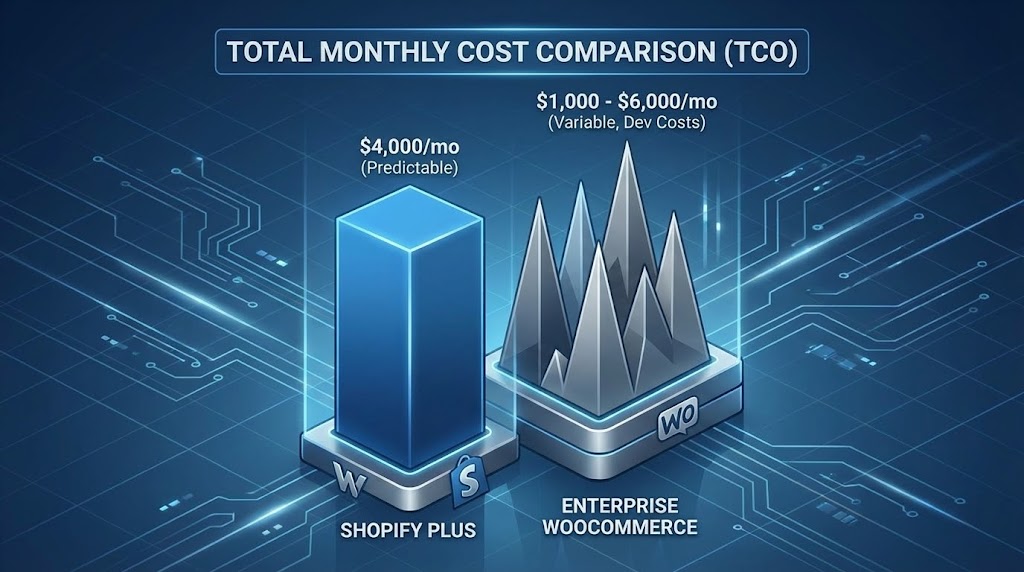
Cost Analysis for High-Volume Sellers (2025)
For small stores, the difference is negligible. For high-volume sellers (doing $1M - $10M+ annual revenue), the cost gap widens significantly.
Shopify Plus: The "Predictable" Expense
High-volume sellers generally graduate to Shopify Plus.
- Base License: Starts at ~$2,300/month.
- Transaction Fees: Even on Plus, if you don't use Shopify Payments, you may face additional fees (0.15% - 0.5% per transaction).
- App Stack: Enterprise scripts and customization apps can add $500–$2,000/month.
- Total Monthly Estimate: $3,000 – $5,000+
Enterprise WooCommerce: The "Variable" Investment
WooCommerce has no license fee, but "free" is a myth at scale.
- Managed Hosting: To handle traffic spikes without crashing, you need premium hosting (e.g., Kinsta, WP Engine) costing $300 - $800/month.
- Development: Maintenance requires ongoing developer support.
- Plugin Licenses: Premium extensions for subscriptions or bookings cost $200 - $500/year.
- Total Monthly Estimate: $1,000 – $2,500 (excluding dev hours).
The Verdict: WooCommerce often has a lower monthly TCO for high-volume sales because it lacks mandatory transaction fees, but it requires a higher upfront investment in development.
Performance: Handling the Traffic Spike
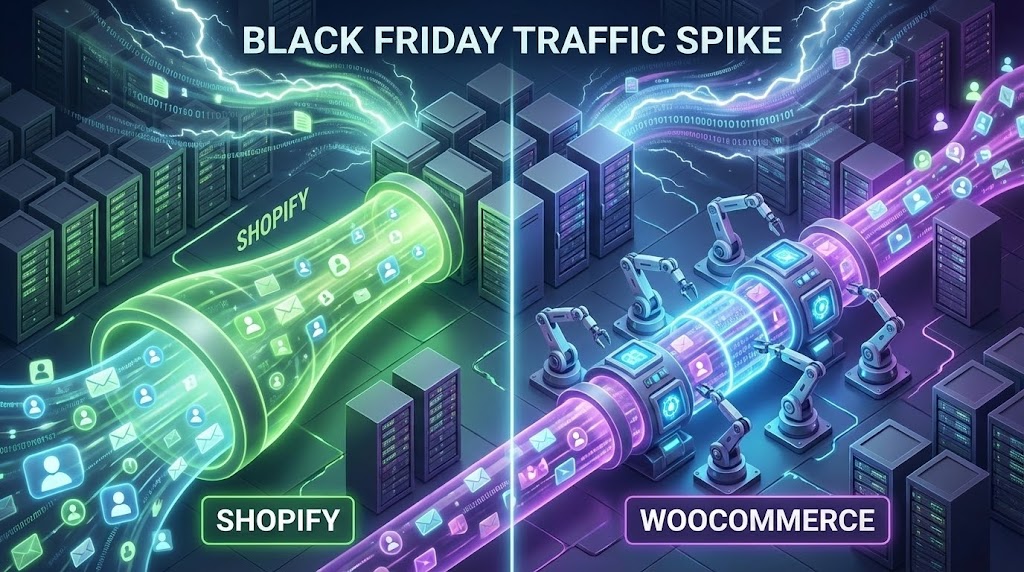
When Black Friday hits, does your site slow down?
- Shopify: Uses global CDNs and elastic servers. It is built to absorb massive traffic spikes automatically. You rarely need to worry about "crashing" due to volume.
- WooCommerce: Performance is entirely dependent on your hosting and code quality. A poorly optimized WooCommerce site will crash under load. However, with WEBBUGGS expert optimization and enterprise-grade hosting, WooCommerce can be faster than Shopify because we can strip out unused scripts that Shopify forces you to load.
SEO & Marketing: Who Wins on Search?
In 2026, technical SEO is critical for ranking in AI Overviews.
WooCommerce (The SEO King)
- Control: You have 100% control over URL structure, robots.txt, and metadata.
- Content: Built on WordPress, the world's best blogging platform. It is superior for content marketing strategies.
Shopify (The Rigid Runner-Up)
- Limitations: Locked URL structures (e.g., you cannot remove
/collections/or/products/from URLs). - Improvements: Shopify has improved significantly, but for complex technical SEO strategies, it can feel restrictive.
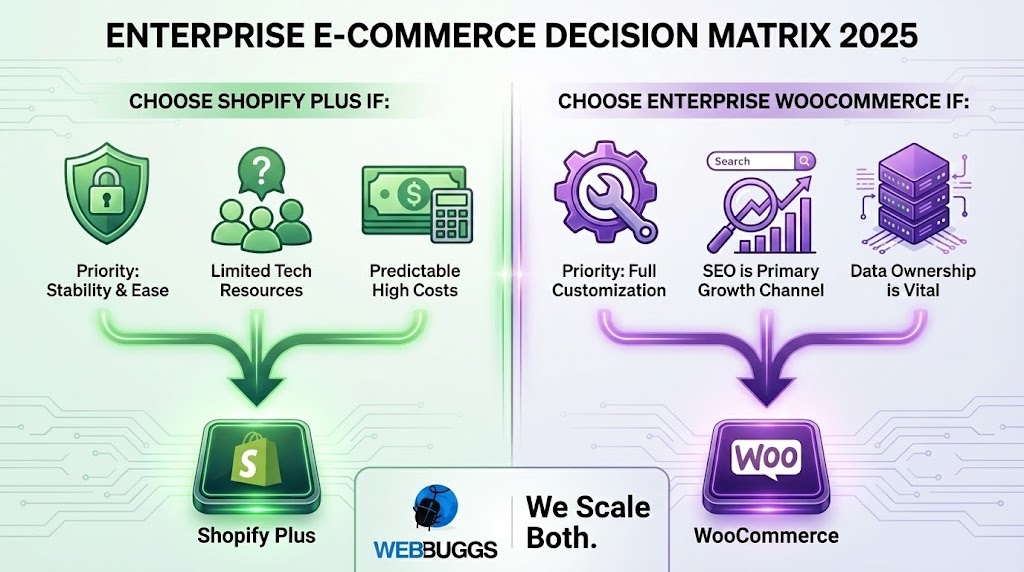
Final Decision Matrix: Which is Right for You?
We recommend Shopify Plus if:
- You want a "set it and forget it" infrastructure.
- Your team lacks technical resources.
- You are willing to pay a premium for stability and ease of use.
We recommend WooCommerce if:
- You require a complex, custom checkout flow.
- You want to avoid transaction fees on high sales volume.
- SEO and Content Marketing are your primary growth channels.
- You want full ownership of your data and tech stack
.png)
%20%E2%80%94%20The%202026%20App%20Store%20Rules%20Nobody%20Told%20You%20About.jpg)